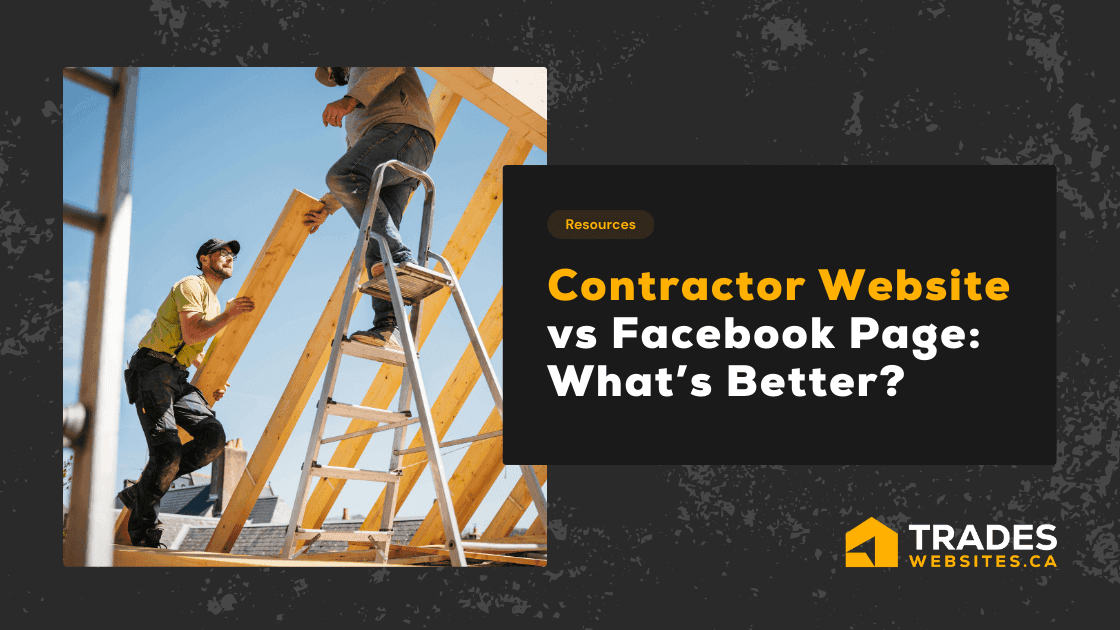
Contractor Website vs Facebook Page — Which Gets More Calls?
A lot of contractors skip the website and use a Facebook page instead. Makes sense on the surface — it's free, easy to set up, and your customers are already on Facebook. Why pay for a website when you can just post photos of your work and let people message you?
Here's why: a Facebook page and a website do completely different jobs. And if you're relying on Facebook as your only online presence, you're missing the customers who are most ready to hire.
How People Find Contractors Online
When someone needs a painter in Hamilton, a fencing company in Vancouver, or a landscaper in Kelowna, they don't open Facebook. They open Google.
They type "painter near me" or "fencing company Vancouver" and look at the results. Google shows them websites, Google Business Profiles, and map listings. Facebook pages rarely show up in these results — and when they do, they're buried below the contractors who have actual websites.
This matters because Google searchers have the highest intent. They need a contractor right now. They're comparing options and ready to call. Facebook users are scrolling. They might notice your post, they might not. The difference in lead quality is massive.
What Facebook Does Well
Facebook isn't useless for contractors. It does a few things well:
Social proof. Photos of your work, before-and-after shots, customer comments — Facebook is great for showing off what you do. When someone checks out your page, they can see real work and real responses from happy customers.
Community reach. Local community groups can be gold for contractors. Someone posts "need a painter recommendation" and three people tag your page. That's a warm lead.
Direct messaging. Some customers prefer messaging over calling. Facebook makes that easy.
But here's the catch: all of this only works when someone is already on Facebook and already looking for you. It doesn't help you get found by people who are actively searching for your trade on Google.
What Facebook Can't Do
Show up on Google. When someone searches "painter near me" or "landscaper Toronto," your Facebook page isn't going to rank. Google prioritises websites with local SEO — proper page titles, location-specific content, structured data. Facebook pages don't have any of that.
Look professional. A Facebook page looks like… a Facebook page. Every contractor's page has the same layout. There's no way to showcase your services, your service area, your credentials, or your portfolio in a way that stands out. It all blends together in the Facebook feed.
Give you control. Facebook owns your page. They control who sees your posts (organic reach has been declining for years — most of your followers don't see what you post). They can change their algorithm, their policies, or their pricing anytime. If Facebook shut down your page tomorrow, your entire online presence disappears.
Capture high-intent leads. People scrolling Facebook aren't actively looking for a contractor. They might see your post and think "I should call them sometime." Google searchers are thinking "I need someone this week." Those are fundamentally different kinds of leads.
The Real Problem With Facebook-Only
Relying on Facebook alone means you're invisible to the biggest source of high-intent leads: Google search.
Think about it from the customer's perspective. Their basement flooded. They need a plumber now. Do they open Facebook and scroll through their feed hoping to see a plumber post? No. They Google "emergency plumber Toronto" and call the first professional result they see.
Their fence blew down in a storm. They need a fencing company. They Google it. Your Facebook page doesn't show up. The contractor with the website does. They get the call.
This isn't hypothetical. This is how the majority of customers find contractors in 2026. And it happens in every city — Toronto, Vancouver, Hamilton, Kelowna. The contractors without websites are losing these jobs every single day.
Website vs Facebook — The Honest Comparison
Getting found on Google: Website wins. Facebook pages don't rank for local trades searches. A properly built website with local SEO shows up when customers search for your trade in your area.
Looking professional: Website wins. Your site tells your story — your services, your work, your reviews, your service area. A Facebook page looks like everyone else's.
Showing off your work: Tie. Both can display photos. But a website lets you organize them by service type and add context. Facebook buries old posts in the feed.
Social proof and community: Facebook wins. Real-time comments, shares, and community group recommendations are hard to beat. But Google reviews on your website are more powerful for converting search traffic.
Control: Website wins. You own it. Nobody can change the rules on you, reduce your reach, or shut you down.
Cost: Facebook is free. A professional website costs $97–$200/month. But "free" that doesn't get you found isn't actually free — it's costing you every job you're missing.
The Smart Approach: Use Both
The best contractors in Canada aren't choosing one or the other. They're using their website as the foundation — the place where Google sends customers who are ready to hire — and Facebook as a supplement for community engagement and social proof.
Your website is your home base. It's what customers find when they Google your trade. It's where your reviews, your portfolio, and your contact info live. It's what converts searchers into callers.
Your Facebook page supports it. Post your work there. Engage with your community. Link back to your website so people who find you on Facebook can see the full picture.
But if you have to pick one? Pick the website. Every time. Because the customers searching Google are the ones most ready to hire — and without a website, you don't exist to them.
The Bottom Line
A Facebook page is a nice-to-have. A website is a must-have. One helps you stay visible to people who already know you. The other gets you found by people who are actively looking for what you do.
$97/month. No contracts. Everything included.
See pricing | If you're curious, book a 15-minute call. No pitch, no pressure.